
The Data-Driven Roadmap to Return to Sport
The moment an athlete feels the sickening pop of an Anterior Cruciate Ligament (ACL) tear, the clock starts on a gruelling journey of rehabilitation. For the serious athlete, the goal is never just to walk again; it is to return to the pitch, the court, or the field at 100 per cent capacity. Historically, the decision to clear an athlete for sport was based on time – the arbitrary six-month or nine-month mark – and a basic clinical exam. However, research now tells us that time alone is a poor predictor of success. To truly mitigate the risk of re-injury, the transition from rehabilitation to performance must be dictated by data, not the calendar.
At Prohab clinics, we move beyond the subjective. The roadmap to recovery is paved with objective testing that removes guesswork and ensures every milestone is met with physical certainty. This data-driven approach is the gold standard for high-level clinical expertise, providing the athlete with the confidence that their graft and their body are ready for the chaotic demands of competitive sport.
The Problem with Subjective Clearance
Traditionally, “feeling good” was the metric for success. An athlete might have full range of motion and no pain, leading them to believe they are ready for match play. Unfortunately, the brain is remarkably adept at compensating for underlying weaknesses. Without sophisticated testing, it is impossible to see if an athlete is subconsciously offloading their surgical limb or if their neuromuscular control is lagging during high-velocity movements.
Returning to sport too early or with unresolved deficits is the primary driver of secondary ACL injuries. Statistics suggest that athletes who return to pivoting sports without meeting strict objective criteria are at a significantly higher risk of a graft rupture or a contralateral ACL tear. This is where the data-driven roadmap becomes a career-saving necessity.
Phase 1: Measuring the Foundation of Strength
Before an athlete can run, they must be strong. In the early to mid-stages of ACL recovery, the focus is on restoring quadriceps and hamstring bulk and function. We utilise Isokinetic Dynamometry and handheld dynamometry to get an exact reading of peak torque and strength ratios.
We look for limb symmetry indices (LSI) of at least 90 per cent. If your surgical leg is only 70 per cent as strong as your non-surgical leg, you are not ready for the next phase of the roadmap. This isn’t a guess; it is a mathematical requirement. High-level performance requires the quadriceps to act as the primary shock absorber for the knee joint. If the strength isn’t there, the stress is transferred to the graft and the meniscus.
Phase 2: Power and Rate of Force Development
Strength is the floor, but power is the ceiling. Being strong in a slow, controlled environment does not translate to the explosive nature of sport. As an athlete progresses, our testing shifts toward Rate of Force Development (RFD) and explosive power.
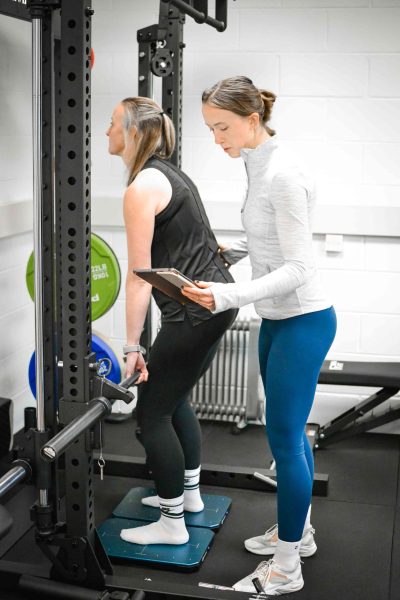
Using dual force plates, we analyse jump mechanics in real-time. We look at the Countermovement Jump (CMJ) and the Drop Jump to assess how an athlete handles eccentric loading and how quickly they can produce force. The data reveals “force traces” that show us exactly how an athlete is distributing weight. Are they leaning away from the injured side during the take-off? Are they landing with more force on the healthy limb? These micro-compensations are invisible to the naked eye but clear as day on a force plate.
Phase 3: The Reactive and Agility Barrier
The final hurdle in the roadmap is the transition from “pre-planned” movements to “reactive” movements. On the pitch, you don’t choose when to pivot; the movement of the ball or an opponent dictates your path. This is where many rehab programmes fail – they stay in the realm of linear, planned drills.
Our data-driven approach includes reactive agility testing and deceleration mechanics. Deceleration is often where ACL injuries occur. We measure how effectively you can put the brakes on. If your deceleration mechanics show a lack of knee flexion or an inward collapse (valgus), the roadmap indicates more work is needed in the gym before you face an opponent.
Psychological Readiness: The Hidden Data Point
The roadmap isn’t just about muscles and ligaments; it’s about the mind. Fear of re-injury is a major barrier to returning to performance. We use validated psychological scales, such as the ACL-RSI (Return to Sport after Injury scale), to quantify an athlete’s confidence. If the physical data says “go” but the psychological data says “no,” the risk of re-injury remains high because hesitant movement is often faulty movement.
Why Prohab Clinics?
The difference between a standard recovery and a Prohab recovery is the level of scrutiny. We treat every athlete like a professional, using the same technology found in Premier League or elite rugby high-performance centres. By following a data-driven roadmap, we ensure that when you finally step back onto the pitch, you aren’t just wondering if your knee will hold up- you know it will.
Your return to sport should be an evidence-based celebration of hard work, not a gamble. By adhering to objective milestones, we protect your career, your longevity, and your passion for the game.
Ready to see where you stand on the roadmap?
If you are currently navigating an ACL recovery and want to ensure you are meeting the necessary benchmarks for a safe return to play, our specialist team is here to help. Whether you need a comprehensive performance assessment or expert physiotherapy, we provide the data you need to succeed.
Book your Performance Testing session today or speak with our specialist Physiotherapy team to start your objective journey back to the pitch.
Frequently Asked Questions
While every athlete is different, a safe return to pivoting sports typically takes between 9 and 12 months. However, our roadmap prioritises meeting objective physical criteria over a specific number of weeks.
There is no single "most important" test. A battery of tests including quadriceps strength symmetry, hop testing for distance and quality, and force plate analysis for landing mechanics provides the most complete picture of readiness.
Biological healing of the graft takes time, but physical readiness depends on training. Research shows that for every month an athlete delays return to sport (up to 9 months), the risk of re-injury is significantly reduced, provided they are also hitting their strength and power milestones.
Failing a test is actually a positive part of the process - it identifies exactly what you need to work on. If the data shows a deficit in hamstring power, we adjust your programming to bridge that gap, ensuring you don't return to play with a known weakness.